

A manila envelope contains the keys upon arrival. Then come the tax bills, the oil delivery invoice, and a voicemail from a neighbor about the gutters. Selling a house through probate in Connecticut isn’t really a real estate problem at first, it’s a paperwork problem wearing a real estate costume. I’ve bought houses across Hartford County and the towns around it for years. Probate files make up a steady share of what crosses my desk. It’s enough that I can usually tell within the first phone call how messy a file will be. The good news: Connecticut probate is more predictable than people fear once you know which door to knock on.
What Is Probate Real Estate in Connecticut?
When somebody dies owning Connecticut real estate in their sole name, the title freezes until a court releases it, which means nothing can be sold or transferred until a judge signs off. Probate is the court-supervised process of proving a will, identifying assets, settling debts and taxes, then passing what’s left to the right people.
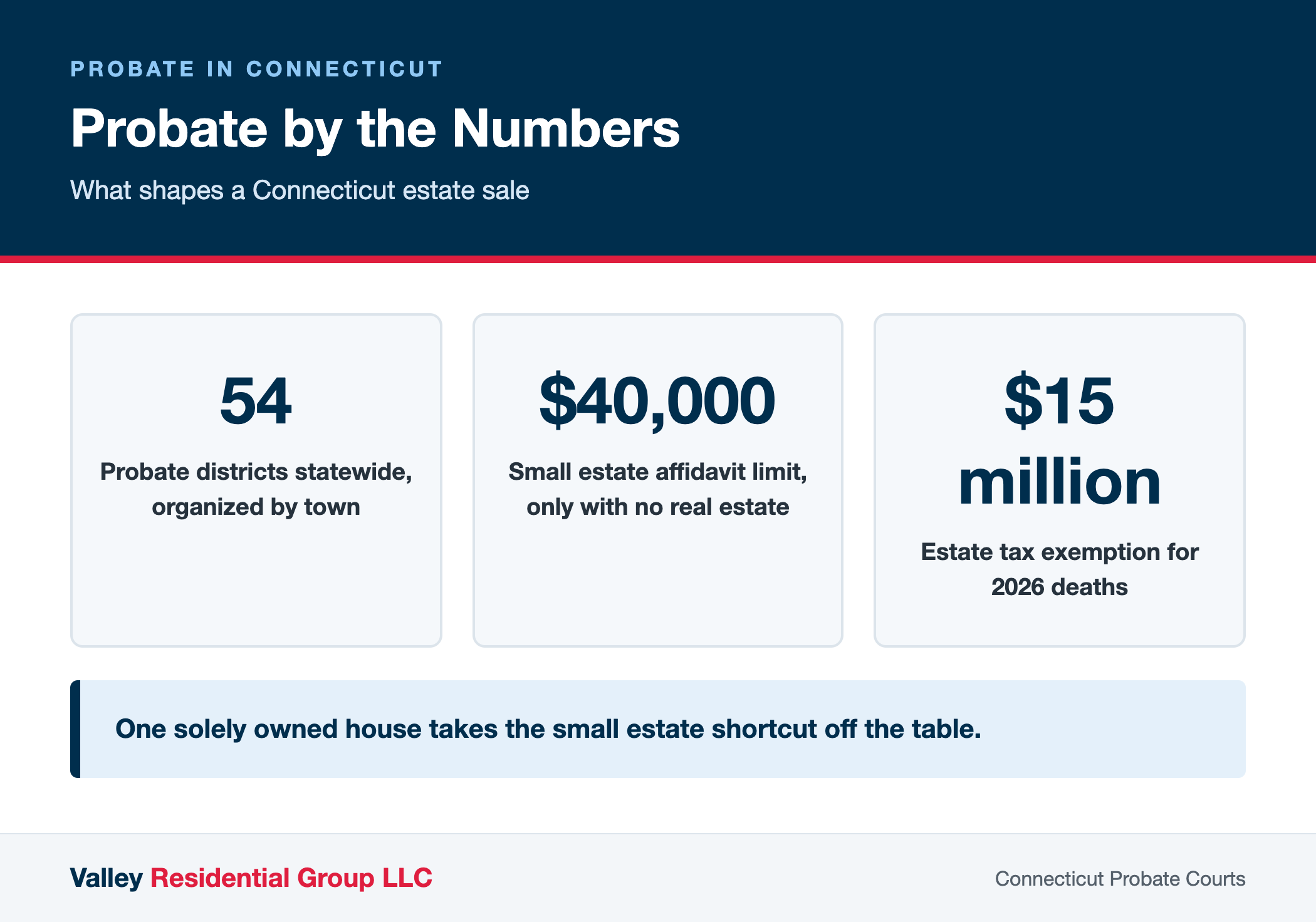
Connecticut handles this differently from other states. There are no county probate courts here, because the state abolished county government back in 1960, so your application goes to the Probate Court for the district covering the town where the decedent lived. Probate in Connecticut is organized into 54 districts rather than counties, and the court locator on the Connecticut Probate Courts site will confirm which one is yours.
How the deed was written controls everything. Property held in joint tenancy with right of survivorship passes outside probate, while solely owned assets need full estate administration.
Market conditions matter here too, because an estate house still has to compete. Connecticut’s single-family median hit $490,000 in September 2026, up 5.4% year over year. Heirs receive that appreciation as a quiet gift.
One more thing about probate real estate in Connecticut: the estate, not you personally, owns the house until distribution.
Does a Will Really Help You Avoid Probate in Connecticut?
A will does not keep you out of Connecticut probate. It tells the court who should run the estate and who inherits, which is useful, but it’s a set of instructions submitted to probate, not a bypass around it.
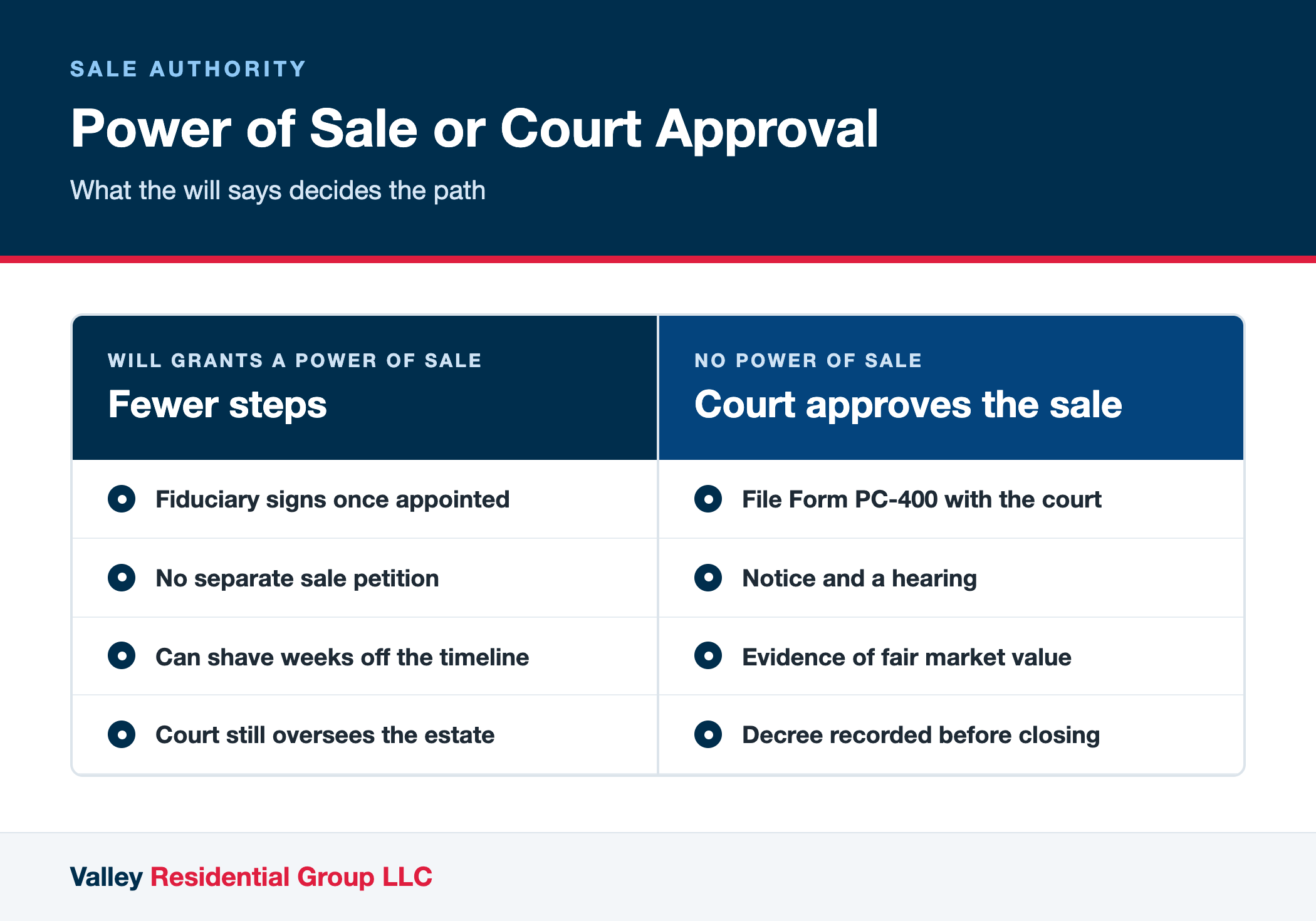
In Connecticut, a fiduciary must get permission from the probate court to sell real estate unless the will specifically grants that power. Many well-drafted wills include it. Without that language, the fiduciary petitions the court, provides an inventory, and presents evidence of fair market value before a sale can move forward. A single clause, often called a power of sale, can shave weeks off your timeline.
A couple of years ago an heir called me from North Carolina about a ranch in Wethersfield. He’d been quietly covering his own mortgage plus his father’s for close to eleven months. He was too polite to ask his siblings for help. The garage still had a snowblower sitting where his dad left it.
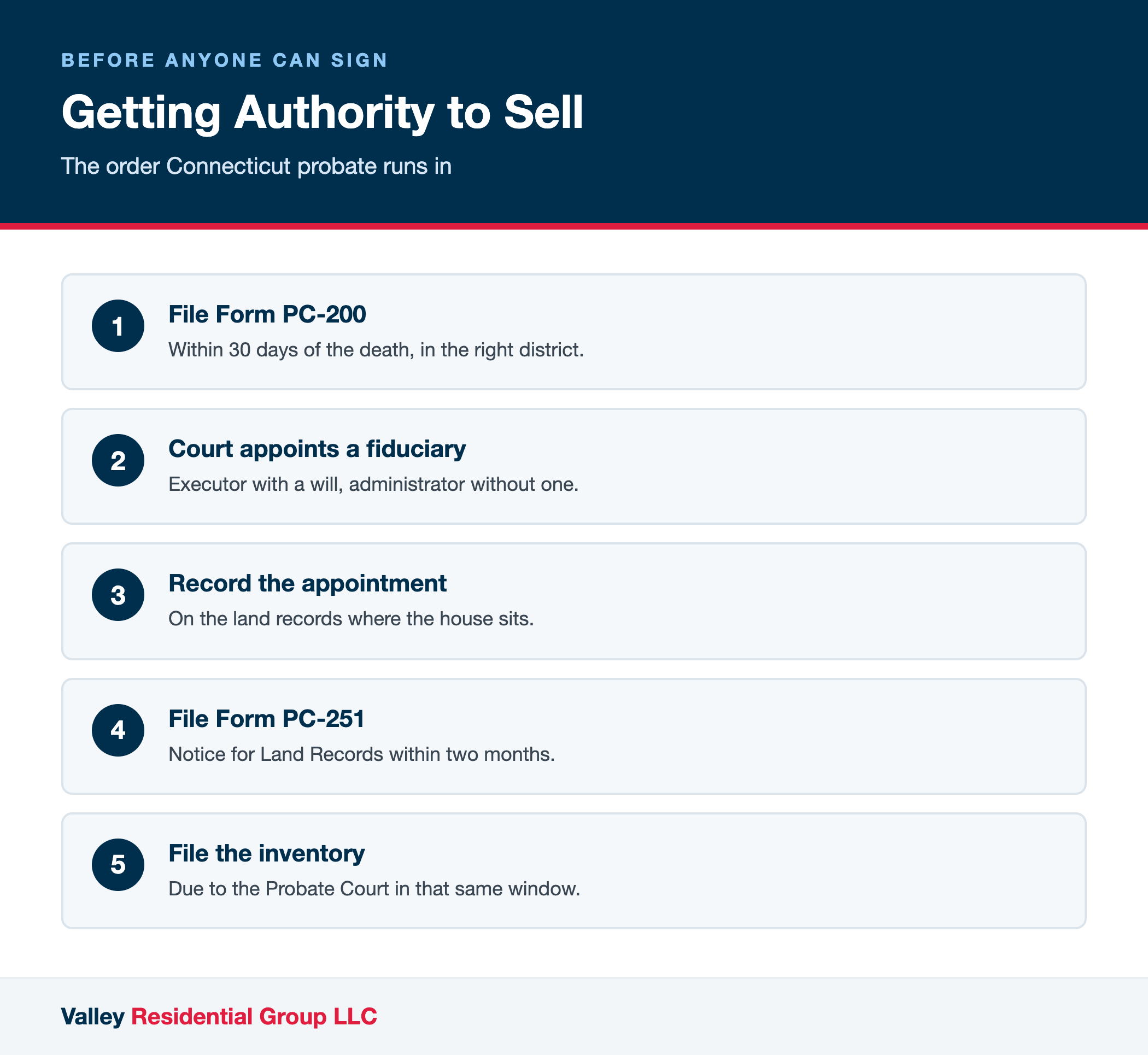
Once probate starts, the will doesn’t change what gets filed. The fiduciary files a Notice for Land Records, Form PC-251, within two months of appointment with the town clerk in each Connecticut town where the decedent owned real estate. An inventory of the estate goes to the Probate Court within that same two-month window.
Taxes surprise fewer Connecticut families than they used to. For people dying during 2026, the Connecticut estate tax exemption is $15 million, and the return is due to the Probate Court within six months of the date of death.
Can You Skip the Probate Process Entirely in Connecticut?
A widow in Manchester thought she faced a year in court after her husband died. Their deed read “joint tenants with right of survivorship,” and her closing happened that spring without a probate file ever being opened.
Exactly two reliable ways exist in Connecticut to keep a house out of probate, and both require planning before the death: survivorship title, or a trust holding the deed.
The small estate shortcut gets mentioned constantly and almost never applies to a house. A decedent holding no solely owned real estate and solely owned assets worth less than $40,000 can have the estate settled by affidavit. This is instead of probate of the will or administration, under Conn. Gen. Stat. § 45a-273 and Probate Court Form PC-212, but owning even one house kills it.
Heirs ask me whether they can just sell the place quietly and sort the court out later. Skip that idea. Nobody can sign a contract to sell a decedent’s real estate until the probate court has formally appointed someone to act for the estate. A title company will catch it, and you’ll lose your buyer.
Should you have a living trust? If you own Connecticut property and have adult children spread across state lines, yes, in my opinion, and the irrevocable versions are a separate conversation with an estate planning attorney. A trust costs money today and saves your family months of probate later.
Buyers in Connecticut rarely blink at estate sales, because so many homes here are old enough to have outlived two owners.
How Does a Connecticut Court Appoint an Executor or Administrator?
Families often arrive at the Probate Court believing the person named in the will walks out that afternoon holding authority.
The sequence runs like this. Someone files the original will with a petition in the correct district. That filing, Form PC-200, Petition/Administration or Probate of Will, goes in within 30 days of the decedent’s death. If no will exists, the court names an administrator to handle the estate under Connecticut intestate law.
Next, the court appoints a fiduciary: executor when a will exists, administrator when none does, and that person holds the legal authority to act for the estate.
You then take the step that determines whether you list in April or August. The Probate Court formally appoints the executor or administrator, and a Certificate of Appointment gets recorded on the local town land records to grant signing authority. Until that certificate hits the land records in Bristol or Southington or wherever the house sits, your signature means nothing to a closing attorney.
Siblings who disagree about who should serve can turn a six-week process into a six-month one, and the carrying costs land on whoever’s paying the bills.
My honest read after watching dozens of these: the sibling who wants the job least usually does it best. If one of you lives near the house in Connecticut and handles details calmly, nominate that person, so the rest of the family can focus on the contents.
Probate here moves at the speed of its slowest filing, so get the petition in early.
When Do You Need a Connecticut Probate Attorney?
If you’re sitting at the kitchen table wondering whether a lawyer is worth it on a $300,000 estate, the answer usually depends on whether anybody is angry.
Straightforward cases exist. One heir, a clear will with a power of sale, no disputed debts, a house everyone agrees to sell: plenty of Connecticut families handle that. They use the court’s own forms and a closing attorney at the end. Probate Court staff can explain procedure, though they can’t give you legal advice about your specific estate.
Bring in counsel when the file has teeth. Multiple beneficiaries who disagree, a will somebody threatens to challenge, an estate where debts might exceed assets, a second marriage with children from both: those situations need legal counsel from the start. If the mortgages against the real estate exceed the property’s value, a short sale enters the picture, and that’s not a do-it-yourself project.
Liens are the reason I tell most Connecticut sellers to budget for an attorney anyway. Statutory tax and probate fee liens are automatically placed on real estate owned by a decedent in Connecticut. Those liens have to be formally released by the court and recorded before closing. Releases come from the Probate Court or from the Commissioner of Revenue Services. Miss one and your closing stops cold at the title search.
What do probate attorneys charge in Connecticut? No statutory fee schedule exists for fiduciaries in Connecticut, who are entitled to reasonable compensation subject to probate court approval.
Court fees are separate and predictable. Connecticut charges one statewide probate court fee, set by Conn. Gen. Stat. § 45a-107. It applies identically across all 54 districts, it’s based on the gross value of the estate, and it sits apart from attorney or fiduciary fees. You can read the court’s own explanation in the Probate Court user guide on administration of decedents’ estates.
How Do You Sell a House in Probate in Connecticut Step by Step?
No auction requirement exists here. Connecticut law doesn’t require probate properties to be sold at auction, though it’s common practice in other states, so you have real choices about how to market the place.
The path runs like this. Open the estate in the right district court, get appointed, record the certificate on the land records, file the inventory, then address the sale authority question. When the will doesn’t authorize a sale, the executor or administrator files a Petition to Sell or Mortgage Real Property, Form PC-400, with the court. Section 45a-164 lets the court authorize a sale on the fiduciary’s written application, after notice and a hearing.
Assurance that the estate is getting fair value is what the court wants, so most sales are backed by a professional appraisal or a solid market analysis from a local agent.
After its review, the court issues a certificate that must be recorded on the land records in the town where the property sits.
Money doesn’t go straight to the heirs. Net proceeds land in an estate checking account you control for estate expenses and debts, but you can’t distribute the final balance to beneficiaries until the probate court authorizes it.
As of October 2026, a typical Connecticut listing spends 42 days on the market before it sells or is withdrawn. Probate adds court time on both ends, not market time in the middle.
Families who want certainty instead of showings often sell the house as-is. That’s where a direct buyer like Valley Residential Group LLC fits: we close on the estate’s schedule, after the decree, with no repairs asked of you.
What Are the Pros and Cons of Selling a Probate House in Connecticut?
Three siblings inherited a cape near the Farmington River with a flooded basement and forty years of accumulation upstairs.
Start with the advantages, because probate sales have real ones. Connecticut housing values have climbed, so estates are often sitting on equity worth more than expected. The entire MLS twelve-month median through late October 2026 ran roughly $440,000 statewide. Heirs also receive a stepped-up cost basis at the date of death, which usually erases most capital gains if you sell reasonably soon, and a tax preparer can run your specific numbers.
Court oversight protects you from each other.
Now the costs. Every month in probate carries insurance, utilities, Connecticut property taxes, and lawn or snow service. Vacant-home insurance is pricier than standard coverage, and Connecticut winters punish empty houses with frozen pipes.
Buyers price in uncertainty too. Probate sales typically require court approval at multiple stages, which can delay closing, and probate properties usually sell as-is.
Condition drags on price more than probate itself does. An estate house with a 1978 kitchen and an oil tank of unknown age gets discounted by every buyer who tours it. This is exactly why some Connecticut families take a clean as-is offer instead of fighting the market.
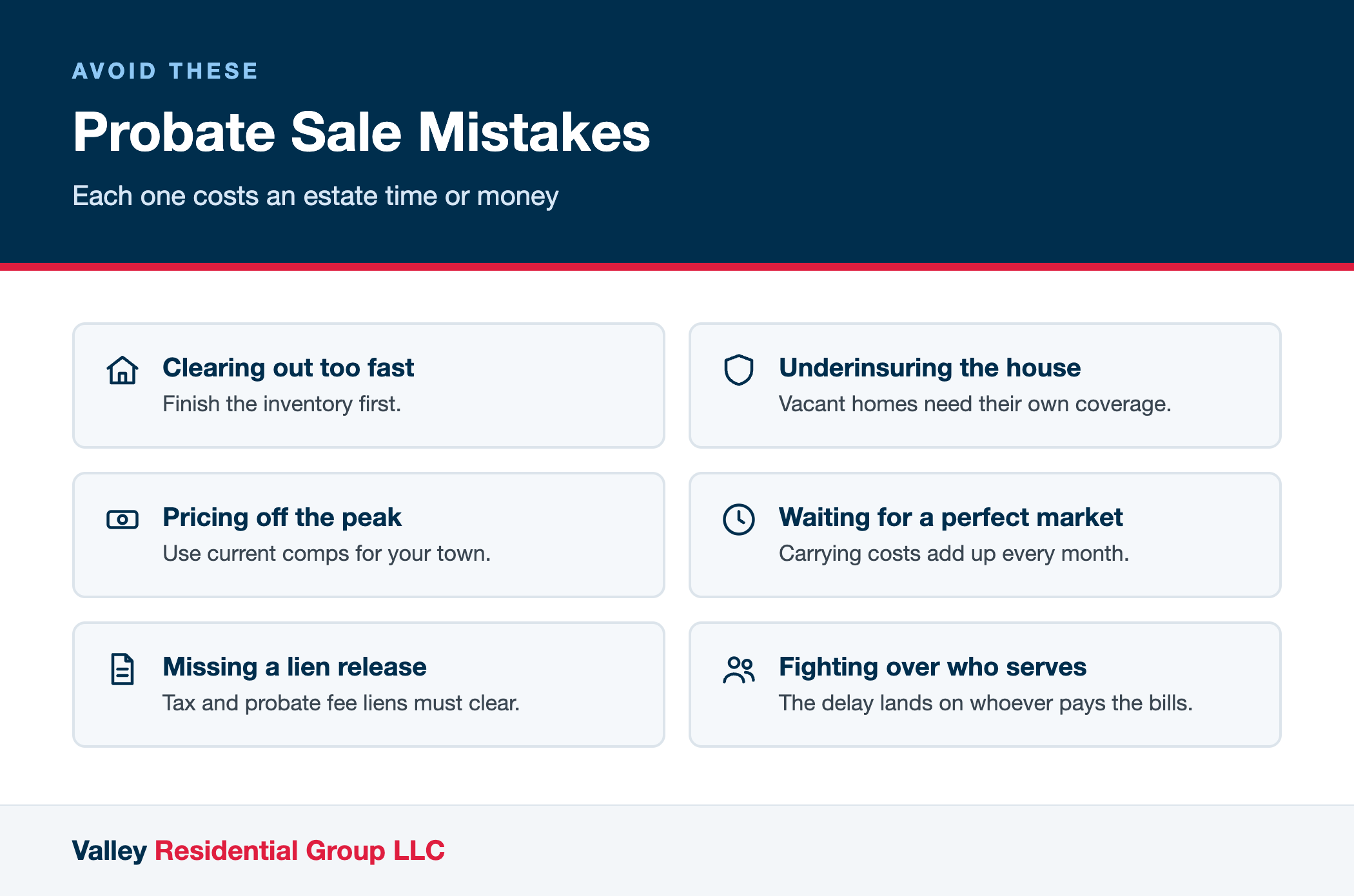
What Mistakes Do Connecticut Families Make During Probate Sales?
$15,000. That’s a fair estimate of what a year of carrying costs runs on a mid-priced Connecticut house: taxes, insurance, heat, and minimum upkeep. Families lose that money while they argue.
Cleaning out too fast is the mistake I see most. Don’t dump furniture or personal property until beneficiaries have completed an inventory and court filings are established. Jewelry, firearms, and savings bonds hide in dressers. A dumpster run on a Saturday can create a probate accounting headache that lasts months.
Underinsuring the vacant property ranks second.
Then there’s pricing. Heirs anchor to what the house was worth at the peak or to what a neighbor got in a different town. Towns twenty minutes apart are not one market. Litchfield County homes ran about $440,000 in the third quarter of 2026, while New Haven County sat near $420,000.
Waiting for a perfect market is its own mistake.
A man called me on a Tuesday afternoon from New Britain, finished with being an accidental landlord. He’d inherited a two-family with a tenant who paid late every month, and he’d never wanted the job; the third-floor attic still held his aunt’s Christmas decorations.
If you want a straight read on whether a listing or a direct sale serves your estate better, read how our process works and then ask us. We’ll tell you honestly, even when the answer is “list it.”
Frequently Asked Questions
Can You Sell a House While It’s Still in Probate?
Yes, and most Connecticut estate houses sell exactly that way, before the estate closes. The fiduciary needs a formal appointment first, plus either sale authority written into the will or a decree from the court after notice and a hearing. Once that’s in place, you can sign a contract, close, and hold the proceeds in the estate account until the court approves distribution to the heirs.
How Does Probate Court Work in Connecticut?
Connecticut runs a dedicated Probate Court system organized by districts tied to towns rather than counties, so you file where the person lived. A judge reviews the petition, appoints a fiduciary, oversees the inventory and creditor claims, approves real estate sales where approval is required, and signs off on the final accounting. Most of the work happens on paper, and many families only appear in person once, if at all.
Do I Have to Fix Up an Inherited Connecticut House Before Selling?
Not at all. Estate properties in Connecticut routinely sell in as-is condition, and the court cares about getting fair value for the estate, not about whether the bathrooms are updated. If you’d rather not spend estate funds on repairs you can’t easily recover, an as-is sale to a local buyer keeps the money in the family’s pocket.
What Happens If the Heirs Disagree About Selling?
Disagreement slows a probate sale more than any court requirement does. The fiduciary generally holds the authority to act in the estate’s best interest, but beneficiaries can request a hearing, and a contested file gets expensive quickly. When siblings are deadlocked, sitting down with a probate attorney early costs far less than a year of carrying a house nobody is maintaining.
Does the Estate Owe Connecticut Taxes When the House Sells?
Nearly all Connecticut estates owe no state estate tax, since the exemption described earlier covers the overwhelming majority of families. The sale itself may create a gain or loss measured against the date-of-death value, which is usually small when you sell within a year or two. A Connecticut accountant who handles estates can confirm your filing obligations before you distribute anything.
Staring at an inherited house with no clear next move? I’m glad to talk it through, whether you end up selling to us, listing with an agent, or keeping the place. No pressure, no obligation, and no charge for a straight answer.
Probate Sales Around Hartford
Hartford County homes sold for a median of about $412,000 in the third quarter of 2026, according to SmartMLS. With that much value tied up in one house, a few slow months in probate can cost an estate real money in taxes, insurance, and heat. Our page for Hartford homeowners explains how we buy there.
Talk to Valley Residential Group LLC About an Estate House
Settling an estate with a house in it? Contact Valley Residential Group LLC and we’ll go over your options with you, no pressure. You can also fill out the short form below.
Helpful Connecticut Blog Articles
- How to Sell an Apartment in Connecticut
- How to Sell Your House Rent-to-Own in Connecticut
- How to Sell a House with Termites in Connecticut
- How Long Does It Take To Force the Sale of Property in Connecticut
- Selling a House with Septic Tank Problems in Connecticut
- Selling a House with a Mortgage in Connecticut
- Who pays taxes when selling a House in Connecticut
- Who pays HOA Fee When Selling a House in Connecticut
- How much does it cost to stage a house in Connecticut?
- Can medical bills take your house in Connecticut?