

A hairline crack in a Glastonbury basement wall cost one seller nothing. Another crack, two towns over, cost that owner a buyer, a lender, and four months. If you’re sitting on a Connecticut house with foundation problems, the gap between those two stories is worth understanding before you call anybody. Foundation problems don’t automatically kill a sale here. They do change who buys, how they pay, and what you’re legally required to put in writing.
Why Are Foundation Problems So Common in Connecticut Homes?
You might be thinking your house stood fine for sixty years, so why would the ground suddenly turn on you now? The answer sits in the dirt under your feet. Glacial till, clay pockets, and ledge run through most of the state, and water moves through all three differently. Add freeze-thaw cycles that hammer basement walls from December through March, and concrete that cures in New England humidity. You’ve got a recipe that produces foundation problems at a pace southern states never see.
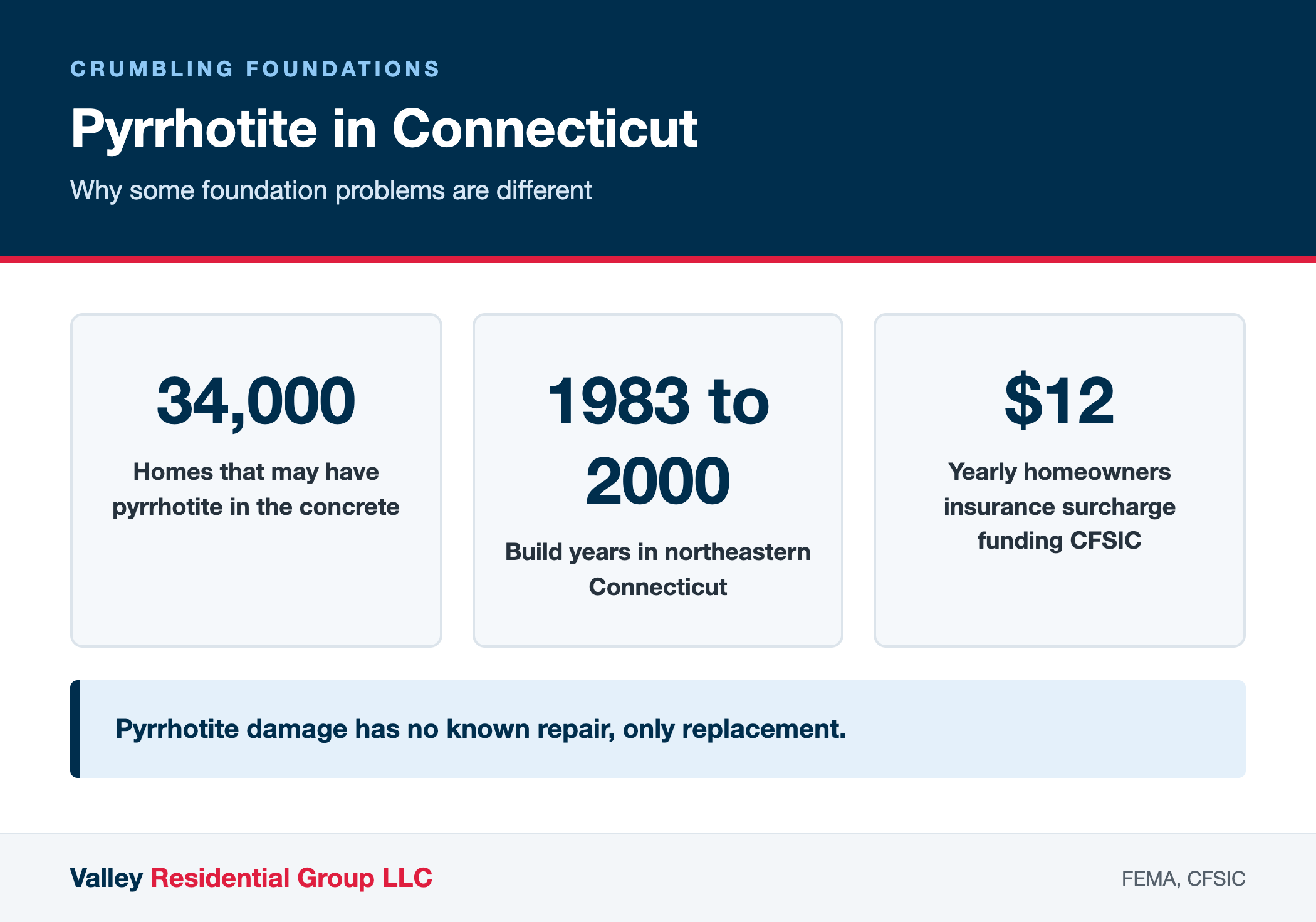
Then there’s pyrrhotite, which turned a regional nuisance into a Connecticut emergency. Federal disaster researchers estimate as many as 34,000 homes built in northeastern Connecticut between 1983 and 2000 may contain concrete foundations with pyrrhotite. It’s an iron sulfide that occurs naturally in the gravel and stone mixed into cement. Once oxygen and water reach it, the mineral swells, so the wall slowly maps itself with spiderweb cracking. Towns across Tolland, Windham, and parts of Hartford County carry the heaviest concentration.
Much of Connecticut’s inventory predates modern drainage standards, so a 1940s rubble foundation in Bristol handles hydrostatic pressure about as well as a colander.
A couple of years ago I sat at a kitchen table in Rocky Hill with a widow. Her late husband had filled thirty years of basement shelving with tools, paint cans, and a disassembled motorcycle in the garage. Her siblings lived out of state and wanted a clean exit, not a renovation project, so the horizontal crack running most of the basement wall’s length wasn’t going to change their minds. We bought it as it sat, and she never had to move a single paint can.
Soils, water, age, and in some towns a bad batch of aggregate: those four forces explain most Connecticut foundation problems. None of them are your fault.
What Qualifies as a Foundation Problem in Connecticut?
Mislabel a cosmetic crack as structural failure and you’ll hand a buyer a discount you never owed. Get it backward, call real movement “settling,” and you’re looking at a failed inspection plus a credibility hole that follows the listing. Both mistakes are expensive, and both are common.
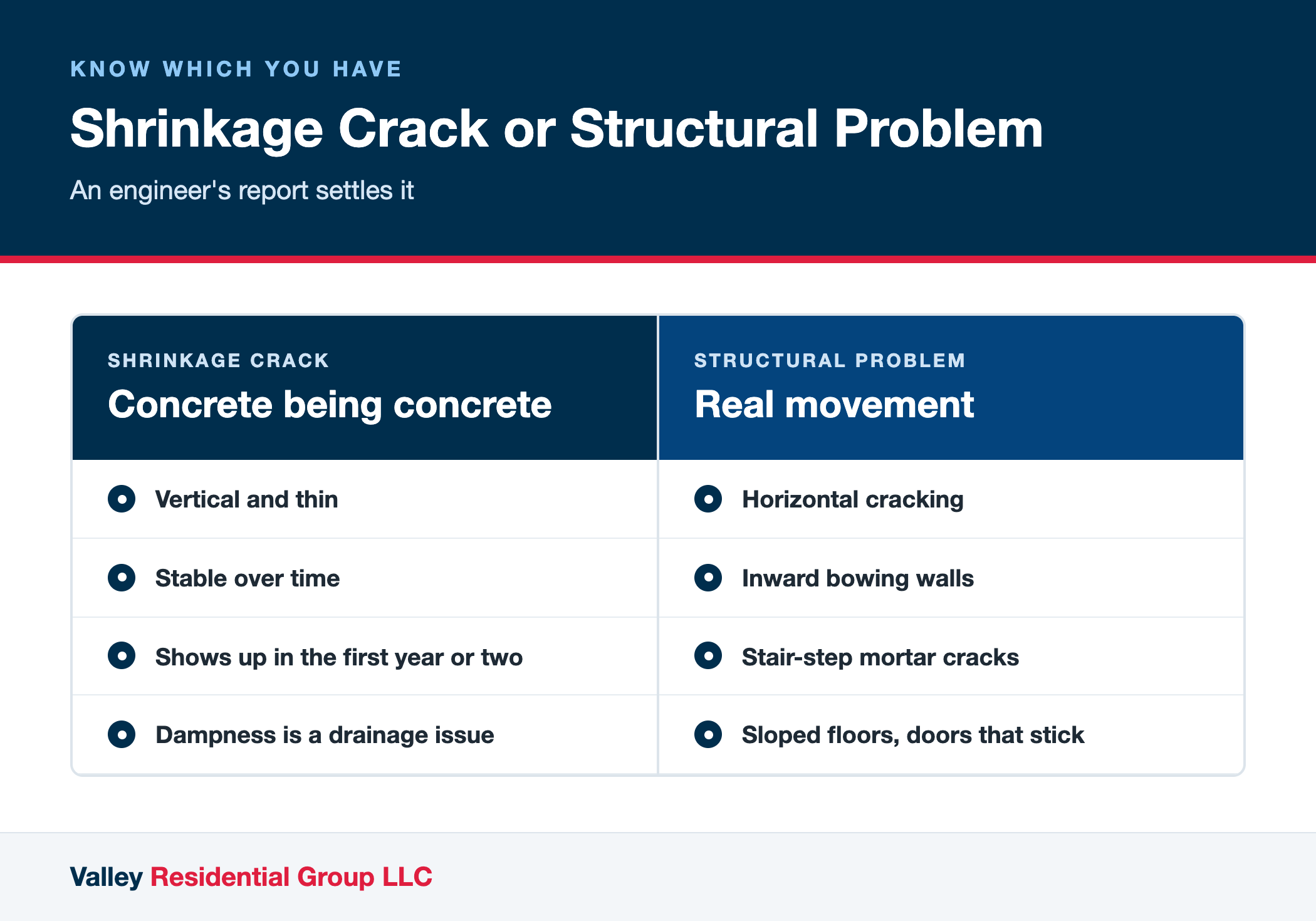
Shrinkage cracks show up in nearly every poured concrete basement in Connecticut within the first year or two after the pour. Vertical, thin, stable. Those aren’t foundation problems; they’re concrete behaving like concrete. Moisture seeping through one is a drainage conversation, not a structural one.
Inspectors treat these as real foundation problems in Connecticut: horizontal cracking across block or poured walls, inward bowing, and stair-step separation through mortar joints. Doors and windows that won’t close square, sloped floors, and crumbling or flaking concrete belong on that list too.
How do you tell which camp you’re in without guessing? Hire a licensed structural engineer, not a foundation repair contractor offering a free estimate. The engineer sells you a report. The contractor sells you a repair. Those are different incentives, and in Connecticut the engineer’s letter is the document a mortgage underwriter will take seriously.
Connecticut towns in the pyrrhotite region also have a specific testing path. A visual inspection comes first, and core sampling with lab petrography costs more but carries more weight with buyers. Either way, you want a document, because a documented condition beats a rumored one every single time in Connecticut real estate.
Do You Have to Disclose Foundation Problems When Selling in Connecticut?
A Vernon seller once told me he’d just “not mention” the basement and let the buyer’s inspector find whatever he found. His attorney shut that down in about nine seconds, and rightly so.
Connecticut doesn’t leave disclosure to your judgment. Under the Uniform Property Condition Disclosure Act, Connecticut General Statutes Section 20-327b, a seller of residential property must give the buyer a completed Residential Property Condition Report. This must happen before that buyer signs any binder, contract, option, or lease with an option to buy. The form asks directly about the foundation, including whether it’s concrete. You can review the official version on the Connecticut Department of Consumer Protection’s site.
Skip the form and pay a price. Connecticut General Statutes Section 20-327c provides that if a seller fails to furnish the required disclosure report, the buyer is entitled to a $500 credit at closing. The logic has a hole in it, because Connecticut’s legislature specified that failing to provide the required report does not excuse a seller from disclosing any significant defects in a residential property. Paying the credit buys you out of the paperwork, not out of telling the truth about foundation problems you know about.
Crumbling foundations from pyrrhotite get their own layer of disclosure. A 2019 act added questions requiring sellers to disclose and explain any knowledge they have about pyrrhotite in the foundation. Some sales now call for a separate foundation report as well. Your closing attorney can tell you whether your specific Connecticut transfer triggers that second form.
My position on this is unpopular with some sellers: disclose early, in writing, with the engineer’s report attached. Buyers negotiate hardest against uncertainty, and foundation problems you’ve already quantified stop being a bottomless pit in their imagination.
What Does It Cost to Fix Foundation Problems in Connecticut?
National averages for foundation repair look reassuring until the engineer walks your Connecticut basement and the scope changes shape. Those averages blend a $300 epoxy injection with a $25,000 settlement fix, so they tell you almost nothing about your house specifically.
This is where Connecticut costs diverge from the national story. Connecticut labor runs higher than in most of the country, and access changes the price too. Excavating around an exterior wall in a tight West Hartford neighborhood with eight feet between houses is a different job than the same work on a half-acre lot in Granby.
Wall anchors, carbon fiber strips, and push piers are the three repairs I see quoted most for Connecticut foundation problems. Anchors and strips address bowing. Piers address settlement, and they’re priced per pier, so the count drives everything.
Pyrrhotite sits in its own category because the damage is described as irreversible, with no known repair. Connecticut built a funding mechanism for this reason, instead of leaving owners alone with it.
If your house sits in an affected town, the Connecticut Foundation Solutions Indemnity Company is your first call before any contractor. A $12 annual surcharge on Connecticut homeowners insurance policies funds the CFSIC program, and foundation replacements have been running through that program since 2019. FEMA’s case study on Connecticut’s crumbling concrete lays out how the state assembled the response. Eligibility rules are specific, so you’re better off confirming your situation directly with CFSIC rather than relying on what a neighbor told you.
How Much Do Foundation Problems Lower Your Sale Price?
Let me say the thing I say at kitchen tables all over Connecticut: buyers don’t subtract the repair estimate, they subtract the repair estimate plus their own fear.
A typical Connecticut listing spends 42 days on the market before it sells or is withdrawn, as of October 2026, according to Curb Report. The same house with visible foundation problems gets a thinner crowd and slower showings.
For ordinary structural issues (bowing, settlement, a wet basement with movement), the hit usually lands somewhere between the repair cost and roughly double it. Buyers price in the unknown behind the wall, the contingency they can’t verify, and the resale conversation they’ll have someday.
Pyrrhotite is harsher. Properties with confirmed pyrrhotite damage typically sell at steep discounts compared with homes on sound foundations. That’s not a negotiating posture; that’s what the Connecticut market does with an unrepairable defect.
A West Hartford colonial with strong schools and walkable Park Road nearby absorbs foundation problems better than an identical house in a town where buyers already have five other options. Scarcity buys forgiveness.
One pattern I keep seeing: sellers who get an engineer’s report and one real contractor bid lose less money than sellers who wing it. When you can hand a buyer a scope and a number, the discount tends to track the number, but without it, buyers invent a worse number. That invented figure is almost always bigger than reality.
Can a Buyer Get Financing on a House with Foundation Problems?
Conventional mortgage financing on a Connecticut house with active structural movement is usually dead on arrival.
Appraisers working FHA and VA files flag safety and structural soundness, so a flagged foundation means repairs get called for before the loan funds. The practical result in Connecticut: your buyer pool shrinks to cash buyers, renovation-loan buyers, and investors.
Renovation loan products exist in the form of FHA 203(k) and Fannie Mae HomeStyle, which both let a buyer finance the price of the house plus repair work in one loan. A renovation loan stretches the usual closing timeline well past a standard mortgage. Does your timeline tolerate a buyer who needs two extra months and a cooperative contractor? Some sellers can wait. Many can’t.
Insurance carriers get cautious about structural defects, and standard policies generally will not cover the cost of repairing or replacing a crumbling Connecticut foundation. No binder, no loan.
For Connecticut lenders, pyrrhotite adds a specific wrinkle. Banks operating in the affected towns know the testing protocols, and some want core results before committing. CFSIC’s homeowner resources are worth reviewing before you list in that region.
This is where a buyer who doesn’t need a loan changes the math. We close on Connecticut houses with foundation problems without an appraisal contingency, because we’re not borrowing against the wall. Valley Residential Group LLC looks at these properties regularly, and the absence of a lender removes the single biggest reason these sales collapse.

Should You Fix Foundation Problems Before Selling, or Sell As-is?
“If I just fix it, don’t I get my money back?”
Sometimes. Not usually in full. If the house were mine, I’d think it through this way.
Repair first makes sense when three things line up: the damage is contained, you’ve got the cash without borrowing, and the Connecticut market in your town rewards move-in-ready inventory. A $4,000 crack injection and a regraded downspout on a Glastonbury split-level can genuinely return more than it costs, because it removes the word “foundation” from the inspection report entirely.
You’ll front $20,000 and live through six weeks of equipment in the yard. Then you’ll face a buyer who still asks for a credit because the work is now a permanent line in the property’s history. That’s the part sellers underestimate: a repaired foundation never reads as “no foundation problems” to a careful Connecticut buyer. It reads as “had foundation problems, and this is the paperwork.”
Selling as-is makes sense when the money isn’t sitting in your account, when you’d have to finance the repair, or when the house is tied up in an estate. It also makes sense when you simply want out of a Connecticut winter with a cracked wall and no contractor returning your calls.
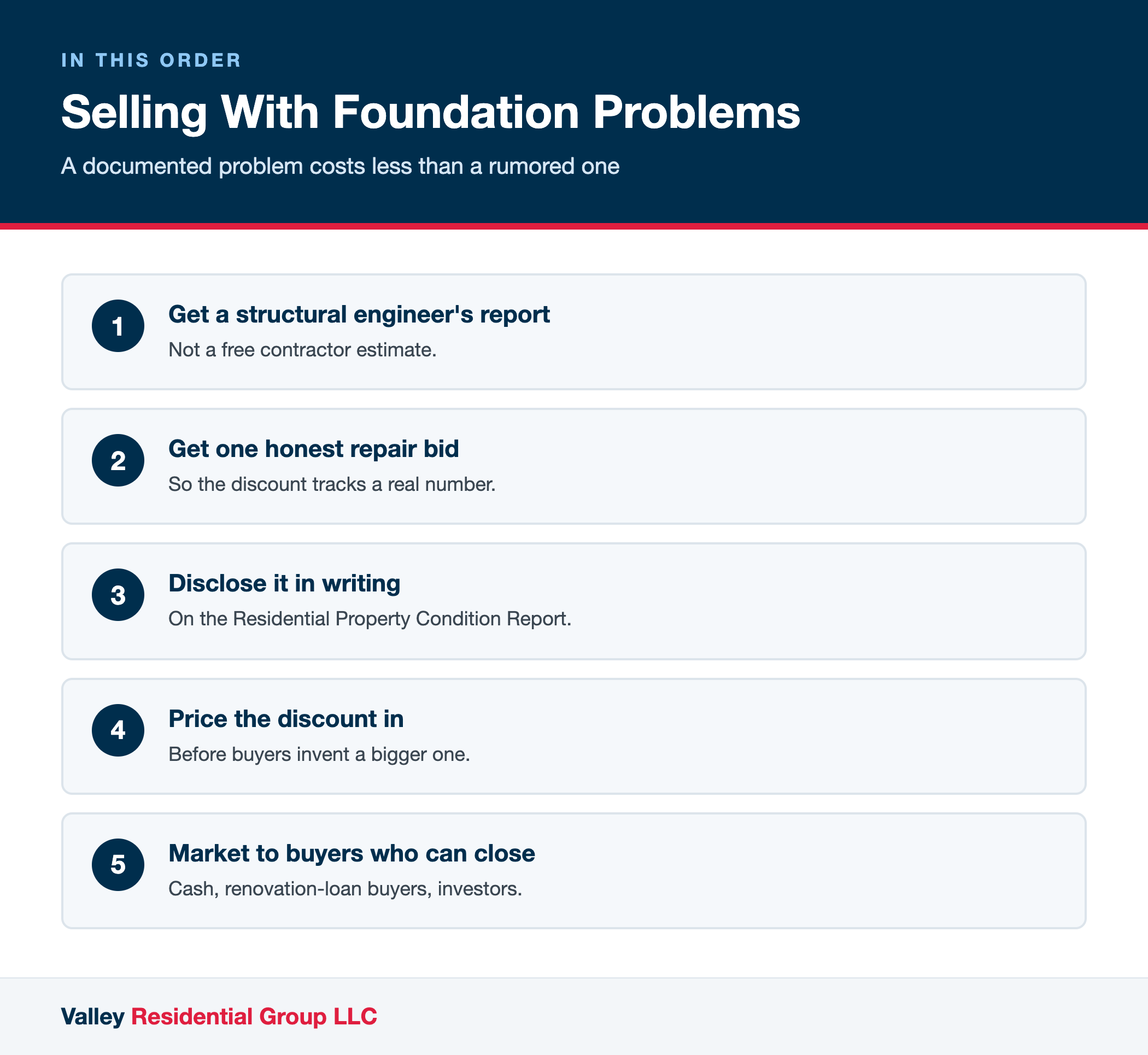
Get the engineer’s report, get one honest bid, price the house with the discount baked in, and sell as-is to a buyer who’s seen foundation problems before. You’re not paying for the repair, but you’re also not paying the fear premium.
Borrowing against your house to fix foundation problems right before you sell it is almost always the wrong move. You’re converting equity into construction risk at the exact moment you want liquidity.
What Are Your Options for Selling a House with Foundation Problems?
A Middletown owner had a bowed rear wall, a listing that had gone stale at 90 days, and two buyers who’d walked after inspection. She sold in under three weeks once she stopped marketing to financed buyers and started marketing to the people who could actually close.
Option one is the traditional listing with a real estate broker. Works best when foundation problems are minor and documented. A good Connecticut real estate brokerage will price the discount honestly and market to the right pool. Expect the commission plus the days on market a compromised property attracts.
The second choice: list as-is with repair credits structured into the sale. This threads the needle on financed offers, though lenders scrutinize large credits.
Option three is selling directly to a cash buyer or investor. No appraisal, no lender, no repair contingency. You trade some price for certainty and speed. Companies like Valley Residential Group LLC buy Connecticut houses in this condition routinely. You can read how our process works before deciding anything, and the offer reflects the real cost of the work rather than a buyer’s worst-case imagination.
Fourth, if you’re in the pyrrhotite region: pursue CFSIC participation before selling. A replaced foundation with program documentation changes your property’s standing in the Connecticut market more than any other single step.
Her garage still had the kayak rack bolted to the ceiling and a chest freezer full of food, and the basement had the step-cracking that scares financed buyers off on a Saturday open house. We handled the closing inside her window and let her leave the freezer.
Which option fits depends less on the foundation problems themselves and more on your timeline, your cash position, and how much uncertainty you’re willing to carry.
Frequently Asked Questions
What Should I Expect to Pay to Repair a Foundation?
National averages for residential foundation repair mix tiny crack injections with major structural work. That makes them a poor predictor for any specific Connecticut house. Your real number comes from a structural engineer’s scope, not a national chart. Crack sealing on a dry basement might be a few hundred dollars; piering one side of a settled house climbs into five figures quickly.
Can I Legally Sell a Connecticut Home That Has Foundation Problems?
Yes, absolutely. Connecticut law doesn’t require you to repair anything before transferring a property; it requires you to tell the truth about what you know on the state disclosure report. Plenty of Connecticut houses with foundation problems change hands every year, usually to cash buyers, investors, or renovation-loan borrowers. Selling as-is is a legitimate choice, not a loophole.
Will Homeowners Insurance Pay to Fix My Foundation?
Rarely. Standard homeowners policies in Connecticut exclude gradual settlement, soil movement, and defective materials, which covers most foundation problems people call about. Sudden events like a burst pipe washing out soil can be a different story, so read your policy and talk to your agent before assuming either way.
How Long Does Selling a Connecticut House with Foundation Issues Usually Take?
Longer than the statewide norm if you’re listing traditionally, because financed buyers and their lenders create extra friction. A direct sale to a cash buyer can wrap in two to three weeks since there’s no appraisal or loan committee involved. Your deed, title search, and attorney’s schedule end up setting the floor on timing.
Does a Structural Engineer’s Report Help or Hurt My Sale?
It helps, almost without exception. An engineer’s letter converts a vague scary condition into a defined one with a scope and a number, and buyers discount defined problems less aggressively than mysterious ones. I’ve watched sellers lose tens of thousands by hiding a report they’d already paid for.
If you’ve got a Connecticut house with foundation problems and you’re not sure which direction makes sense, I’m happy to look at it with you and talk through what the numbers really look like. Sometimes the answer is list it with an agent, and I’ll tell you that. If a straightforward as-is sale is the better fit, we can walk through that too. No pressure, no obligation, and no one will push you toward a decision you’re not ready to make.
Foundation Problems Around Hartford
Hartford County homes sold for a median of about $412,000 in the third quarter of 2026, according to SmartMLS. On a house at that price, the gap between a documented foundation problem and a rumored one can easily run into five figures. Our page for Hartford homeowners explains how we buy there.
Talk to Valley Residential Group LLC About Your House
Have a Connecticut house with a cracked or bowing foundation? Contact Valley Residential Group LLC and we’ll go over your options with you, no pressure. You can also fill out the short form below.
Helpful Connecticut Blog Articles
- How to Sell an Apartment in Connecticut
- How to Sell Your House Rent-to-Own in Connecticut
- How to Sell a House with Termites in Connecticut
- How Long Does It Take To Force the Sale of Property in Connecticut
- Selling a House with Septic Tank Problems in Connecticut
- Selling a House with a Mortgage in Connecticut
- Who pays taxes when selling a House in Connecticut
- Who pays HOA Fee When Selling a House in Connecticut
- How much does it cost to stage a house in Connecticut?
- Can medical bills take your house in Connecticut?