


A letter from a law firm lands on your kitchen table in Bristol. Inside is a summons with a return date, and suddenly the word foreclosure stops being abstract. I’ve sat across from hundreds of Connecticut homeowners at that exact moment, and the fear almost always outruns the facts. You have more runway than the envelope suggests. But runway only helps if you know which direction to run, and in Connecticut the rules are genuinely different from what you’ll read on national websites.
What’s the Difference Between Mortgage Foreclosure and Property Tax Notices in Connecticut?
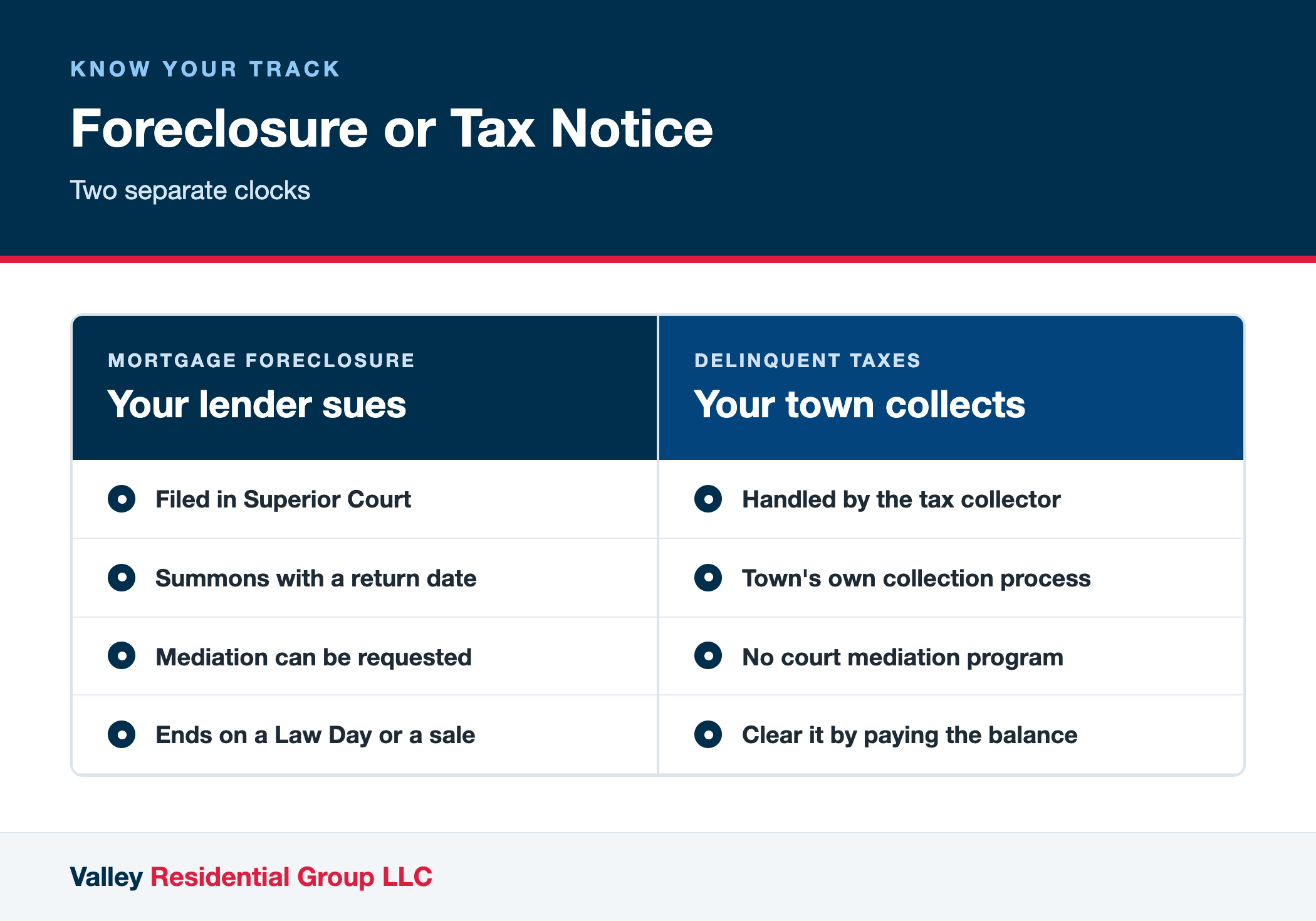
Demand letters from your town’s tax collector and a mortgage foreclosure complaint from your lender travel on completely separate tracks, with different timelines and different people holding the pen.
Your lender starts a mortgage foreclosure by filing a lawsuit in Connecticut Superior Court. Foreclosures in Connecticut are judicial, so they move through the court system rather than through a trustee. A summons, return date, and paperwork about mediation come with that filing. A municipal tax issue doesn’t look anything like that. Towns pursue delinquent taxes through their own collection process, and your town’s tax collector is the office that can tell you exactly where your account stands and what it would take to clear it.
Why should you care so much about the distinction? Because the clock you’re watching determines which phone call saves your equity. Mortgage foreclosure in Connecticut gives you access to a court-run negotiating table, while tax delinquency offers no such thing.
A while back I worked with the adult children of an elderly homeowner in Cheshire. They’d been watching their father’s mortgage fall behind for months, and the garage was still full of the father’s woodworking equipment. What they wanted wasn’t a bidding war; they wanted someone to handle the sale cleanly so they could stop arguing about it. We closed on a Thursday and they left the workbench behind.
Pull every notice you’ve received, sort them by sender, and figure out which track you’re on before you do anything else. If both a mortgage foreclosure and unpaid property taxes are in play, the mortgage case usually sets the controlling deadline, since that’s the matter already in front of a judge.
What Happens During a Connecticut Foreclosure Sale?
Few states resemble Connecticut, where most cases never reach a public auction at all. The majority of foreclosures here are strict foreclosures, and that word “strict” carries real consequences.
In a strict foreclosure, there’s no bidding and no highest bidder. Instead of setting a sale date, the court sets a Law Day for you and any other parties with an interest in the property. If nobody redeems, title simply vests in the foreclosing lender once all law days have expired. Your ownership ends quietly, on a calendar date, without a crowd.
How much time does that leave you? The judge sets the Law Day when entering judgment, and it’s printed on the paperwork your attorney receives.
Foreclosure by sale is also allowed in Connecticut, which looks more like what people picture. A court ordering a foreclosure by sale sets a sale date, usually a Saturday. It appoints a Connecticut attorney as a committee to advertise and run it. A fresh appraisal is also obtained by that committee. Judges tend to choose this route when there’s meaningful equity worth protecting.
One detail gets overlooked constantly, and it’s the one that costs people money. No redemption window is given after the fact in Connecticut; the chance to redeem comes before the Law Day in a strict foreclosure, or before the sale in a decree of sale foreclosure. Once that date passes, the house is gone and so is any equity above the debt. Connecticut’s own Judicial Branch foreclosure resources spell out the homeowner’s role at each stage, and I’d read them before your first court date rather than after.
What If You Owe More Than Your Home Is Worth in Foreclosure?
The common mistake usually runs in the homeowner’s favor. Years of rising Connecticut prices have quietly rescued plenty of people from a foreclosure they thought was hopeless. Before you assume the worst, get a current payoff figure from your servicer and a real opinion of value from somebody who sells in your town.
Sometimes the math genuinely doesn’t work. The word “deficiency” starts to matter at that point, and Connecticut permits it. State law lets a lender seek a deficiency judgment in both decree of sale foreclosures and strict foreclosures. In a strict foreclosure the deficiency is capped at the gap between the total debt and the fair market value the judge determines. The lender has to file that motion within 30 days after the Law Day.
Short sales exist for exactly this situation, and they work better in Connecticut than their reputation suggests. Your servicer agrees to release the lien for less than the full balance so a sale can close. Getting the deficiency expressly waived in writing is the whole ballgame, because a short sale that leaves the shortfall unresolved just converts a foreclosure into a lawsuit.
Vague interest doesn’t move a loss mitigation department. A signed contract does.
Can Selling Your Connecticut Home Stop a Foreclosure?
Plenty of homeowners picture a quick sale as something they can trigger the week before the Law Day. But even a fast closing needs title work, a payoff statement from the servicer, and a recorded deed. Servicers in Connecticut are not known for same-week turnarounds on payoff demands.
Selling absolutely can stop a foreclosure, right up until title vests.
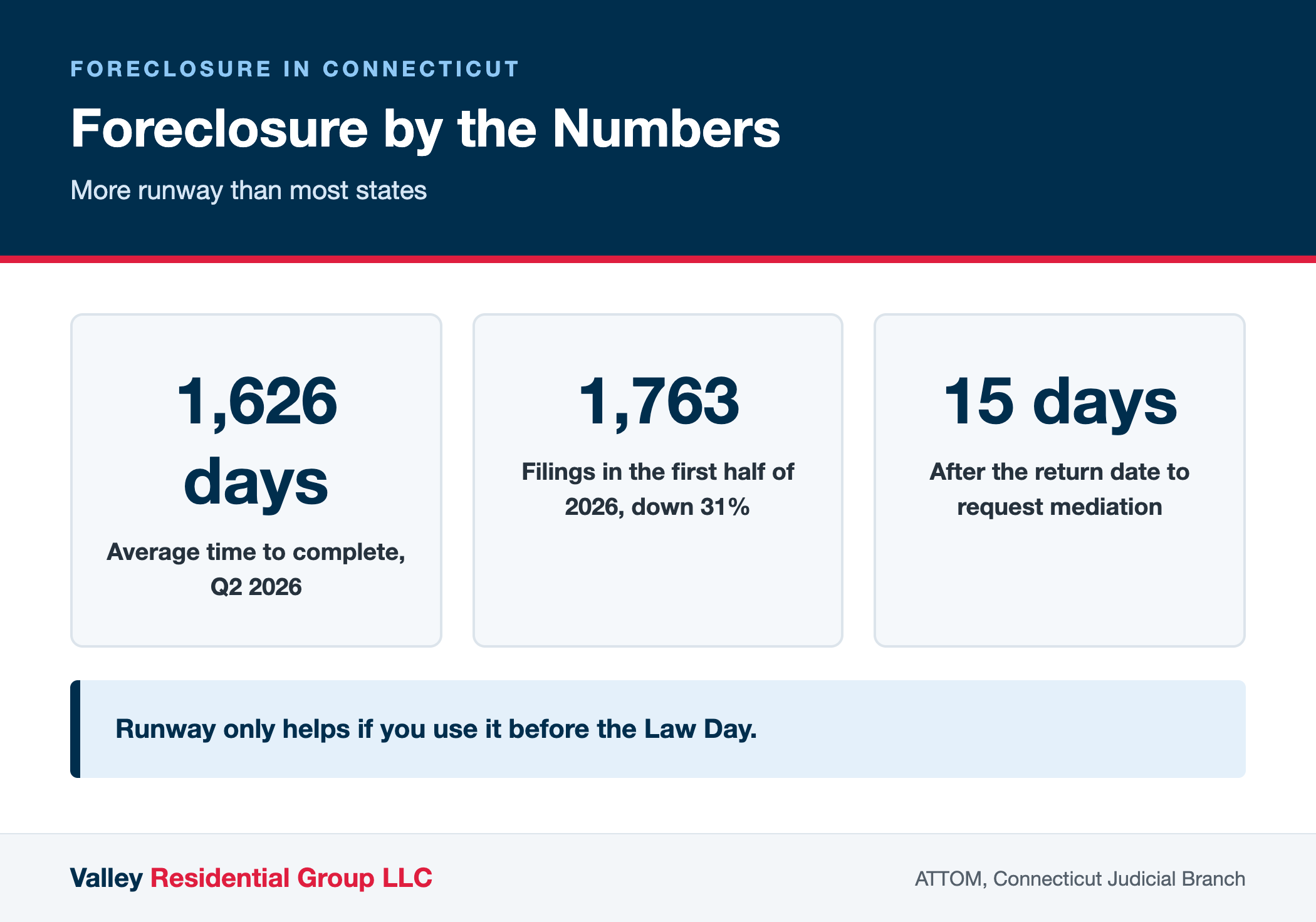
Connecticut hands you an advantage here that most states don’t. According to ATTOM’s mid-year report, homes that completed foreclosure in the second quarter of 2026 had been in the process an average of 1,626 days in Connecticut. That’s one of the longest timelines in the country. It works out to more than four years, on average, from start to finish. A judicial system plus a mandatory mediation program creates breathing room that a Georgia or Texas homeowner would envy.
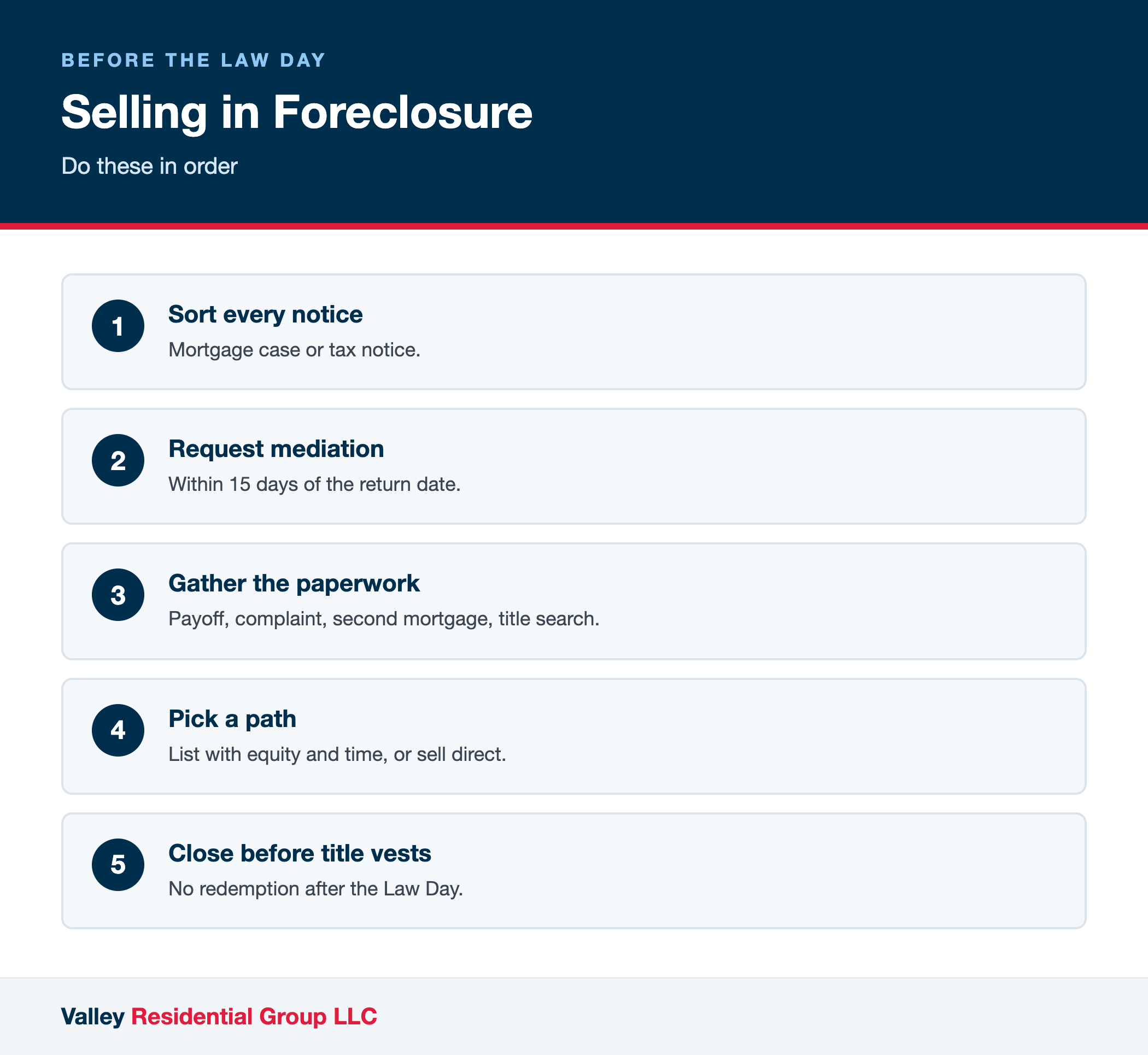
To request it, you file an Appearance and a Foreclosure Mediation Certificate within fifteen days of the return date on your summons. There’s no application fee. Mediators are Judicial Branch employees trained in both mediation and foreclosure law. Eligible cases involve one- to four-family, owner-occupied Connecticut property used as the homeowner’s primary residence. The Connecticut Law About Foreclosure Mediation page lists the forms by number.
You can file a motion asking permission to submit the certificate late, and if a judge grants it you’re back in the program. I’ve watched sellers use the mediation period to market a house properly instead of dumping it, and that extra time frequently translates into real dollars.
How Do You Sell a House in Foreclosure in Connecticut?
Forty-two days. That’s how long a typical Connecticut listing sits before it sells or gets pulled, as of October 2026. Add closing time on a financed buyer and you’re realistically three months out from the day you sign a listing agreement. Measure that against your Law Day before you choose a path.
Step one for a Connecticut seller is gathering documents nobody enjoys gathering: the current payoff, the foreclosure complaint, any second mortgage, and a title search. An old contractor’s lien or a municipal assessment can stall a closing that was otherwise ready to fund.
Deciding between the open market and a direct sale is step two. Listing makes sense when you have equity, time, and a house that shows well.
Tell your Connecticut attorney what you’re doing. Closings in Connecticut run through attorneys, not title companies, and a foreclosure file sitting in Superior Court needs someone coordinating with the lender’s counsel. Buyers who’ve never handled a Connecticut foreclosure sale tend to discover this on closing day.
For homeowners around Hartford and the surrounding towns, Valley Residential Group LLC handles foreclosure situations regularly and knows how to work alongside a lender’s attorney without blowing up the court timeline.
Is a Cash Sale Better Than Listing a Foreclosure Property?
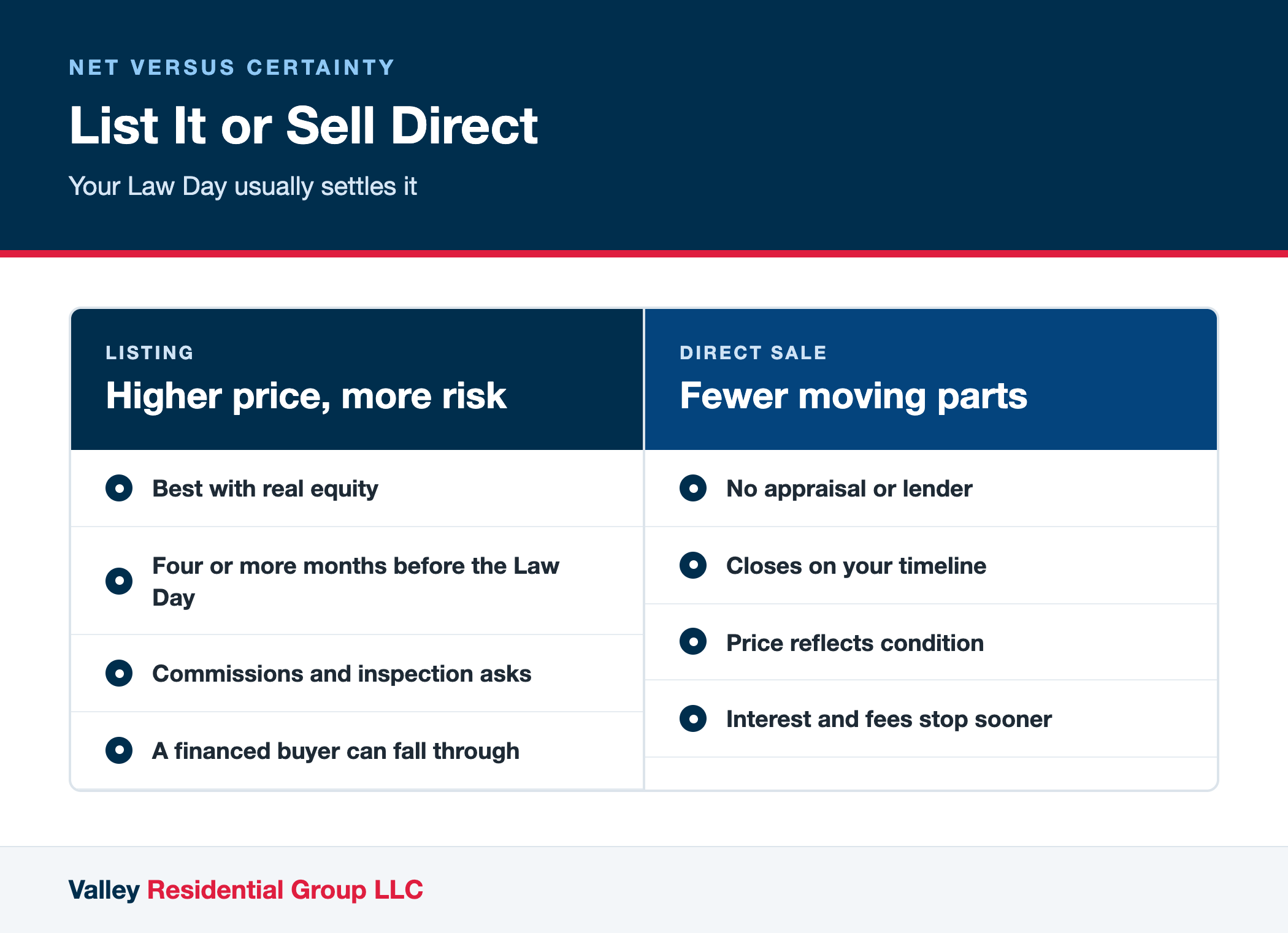
And that brings up the comparison every Connecticut seller eventually makes: net proceeds versus certainty. A listing brings agent commissions, inspection renegotiations, appraisal risk, and a financed buyer whose loan can collapse in week six.
Run the actual subtraction. Take out both agent commissions, attorney fees, and whatever repairs an inspector finds. The gap between a retail offer and a direct offer narrows fast on a distressed property.
Every month a Connecticut foreclosure stays open, interest, late charges, and the lender’s legal fees are added to your payoff. A sale that closes two months sooner at a slightly lower price can leave you with more money.
There’s no universally right answer, but a Law Day ninety days out tends to settle the argument.
Buyers feel seasonality too, which means Connecticut homes move fastest between April and July, and winter months carry the longest market times. A foreclosure that lands you on the market in January in Torrington is a tougher sell than the same house in May.
My honest take after years of doing this: sellers with real equity and four or more months before their Law Day should list. Everyone else should at least price out a direct sale before committing to a listing they may not have time to complete.
What Are Connecticut Homeowners Asking About Selling Before Foreclosure?
I used to tell people that a foreclosure filing automatically tanked their sale price, and that was wrong, so I’ve since changed how I explain it to sellers. Connecticut buyers rarely know a case is pending unless the property sits long enough for the lis pendens to surface in a search.
Homeowners now ask whether anyone’s buying at all, given where mortgage rates sit. They are. Connecticut recorded 1,763 foreclosure filings in the first half of 2026, down 31 percent from the same stretch in 2025. Fewer distressed properties competing for attention is good news if you’re the one selling.
Does mediation stop you from selling?
It doesn’t. Participating in the Ezequiel Santiago Foreclosure Mediation Program waives none of your rights in the foreclosure action, because Chapter 846 of the Connecticut General Statutes governs the mechanics. You can negotiate with your lender and market the house simultaneously.
A couple in Glastonbury reached out after moving the wife’s mother into assisted living. The house had a sunroom the mother had added in the eighties, a mortgage three payments behind, and two siblings in different states who couldn’t agree on anything. So what they needed was one decision point instead of five. We handled the sale, they split the proceeds, and nobody had to fly in for a cleanout weekend.
Deciding who to trust comes up a lot too. Fair question in a foreclosure, where unsolicited mail arrives by the pound. Ask any buyer for recent Connecticut closings, read their reviews, verify proof of funds, and never sign anything that transfers your deed before you understand what happens to the underlying debt.
What Do Connecticut Sellers Say About Avoiding Foreclosure?
“Will I walk away with anything?”
That’s the first question, nearly every time, and for Connecticut homeowners with any equity the answer is usually yes. Connecticut’s single-family median hit roughly $490,000 in September 2026, up 5.4 percent year over year, and that appreciation sits underneath a lot of foreclosure cases as a cushion nobody calculated.
Connecticut sellers consistently tell me the relief came from the decision itself, not the money. Living inside an open foreclosure is exhausting in a way that’s hard to describe to anyone who hasn’t done it: the mail, the phone calls, the neighbors who somehow know. Picking a direction ends that part.
A homeowner who calls during mediation has choices. A homeowner who calls two weeks before the Law Day has one, and it isn’t the best one.
Something else comes up often. People fear that selling during a foreclosure means accepting an insulting number out of desperation, but that’s not how it has to go. In a market where Connecticut inventory remains tight and prices keep climbing, a reasonable offer on a distressed property is still a reasonable offer. Desperation pricing is a choice, not a requirement, and you should refuse it.
If you want a second opinion on your numbers, see how our process works, and we’ll go over your payoff, your timeline, and what a direct sale would net versus a listing. No obligation attaches to that conversation.
Frequently Asked Questions
Who Gets Paid First in a Foreclosure?
Payment follows lien priority, which generally means the order things were recorded. Municipal tax liens typically sit at the front of the line, followed by your first mortgage, then any second mortgage or home equity line, then judgment liens and mechanic’s liens. Anything left after every lienholder is satisfied belongs to you. In a strict foreclosure, though, there’s no sale generating proceeds to distribute, which is exactly why selling before the Law Day protects equity that the process otherwise absorbs. If bankruptcy is also on the table, talk to an attorney before choosing.
Can I Sell My House After a Foreclosure Case Has Already Been Filed?
Yes, and people do it constantly in Connecticut. Filing a foreclosure complaint doesn’t strip your ownership; you hold title until the court-set date passes or a sale is confirmed. Your closing attorney coordinates a payoff with the lender’s counsel, the lien gets released, and the case gets withdrawn. The practical constraint is calendar time, not permission.
Does a Foreclosure Filing Hurt My Credit Even If I Sell Before It Finishes?
Missed mortgage payments damage your credit regardless, since servicers report those monthly. A completed foreclosure, though, is a separate and heavier mark that sticks around for years and affects future mortgage lending. Selling before the process concludes keeps that final entry off your report, which usually shortens how long you’ll wait before qualifying for another loan.
What If My House Needs Major Repairs and I’m in Foreclosure?
Repairs rarely pencil out when a court deadline is approaching. Financed buyers need the property to pass appraisal and inspection, so a failing roof or an old oil tank can kill a retail sale outright. Selling as-is to a buyer who prices the condition into the offer removes that risk entirely, and in a Connecticut foreclosure, eliminating risk often beats chasing the highest number on paper.
Will I Still Owe Money After Selling During Foreclosure?
If your sale covers the full payoff, you owe nothing and you keep whatever remains. If you’re short, the lender’s agreement to release its lien does not automatically erase the unpaid balance, so the release language your attorney negotiates matters enormously. Get any waiver of the remaining debt in writing before you close, not after.
How Do I Know If My Connecticut Foreclosure Is Strict or by Sale?
The judgment document says so plainly, and your court file will show which one the judge entered. Before judgment, you can often predict it from your equity position: substantial equity pushes a judge toward ordering a sale, while an underwater property more often ends in the strict version. Your attorney or the Superior Court clerk’s office where your case was filed can confirm what’s on the docket.
If your Law Day is on the calendar and you’re trying to figure out whether selling makes sense, reach out and we’ll run the actual numbers together. Bring your payoff statement and your court paperwork. We’ll tell you honestly whether listing, a short sale, or a direct sale serves you best, even when the answer means we aren’t the right buyer for your house. No pressure, no obligation, just a straight conversation about your Connecticut home.
Foreclosure Help Around Hartford
Hartford County homes sold for a median of about $412,000 in the third quarter of 2026, according to SmartMLS. That’s a lot of equity to hand a lender on a Law Day when a sale could have protected it. Our page for Hartford homeowners explains how we buy there.
Talk to Valley Residential Group LLC Before Your Law Day
Facing a foreclosure deadline? Contact Valley Residential Group LLC and we’ll go over your options with you, no pressure. You can also fill out the short form below.
Helpful Connecticut Blog Articles
- How to Sell an Apartment in Connecticut
- How to Sell Your House Rent-to-Own in Connecticut
- How to Sell a House with Termites in Connecticut
- How Long Does It Take To Force the Sale of Property in Connecticut
- Selling a House with Septic Tank Problems in Connecticut
- Selling a House with a Mortgage in Connecticut
- Who pays taxes when selling a House in Connecticut
- Who pays HOA Fee When Selling a House in Connecticut
- How much does it cost to stage a house in Connecticut?
- Can medical bills take your house in Connecticut?